ζ—₯本θͺž Β· the NihonGO system

From finished beginner
to reading real Japanese.

NihonGO Manabi is the whole intermediate road in one course β€” thirty-six chapters across three books, following one continuing story, where every word, kanji and grammar pattern is one tap from a card that explains it. Two companion apps drill the same deck and put it to work in literature.

Built for the intermediate years

Β· the complete intermediate series

36Chaptersthree books, one story
330+Grammar patternsall of N3 and N2
755Kanjievery N3 and N2 character
~7,500Exerciseswith model answers
NihonGO Dominos The drill Β· iPhone & iPad Β· free On the App Store now
The flagship NihonGO Manabi The course Β· iPhone, iPad & Mac Β· free Arriving 15 December 2026
NihonGO Dokusho The reader Β· iPhone & iPad Β· free On the App Store now
Who it's for

Made for the intermediate years.

Just starting out?

Not yet. You'll want kana and your first few hundred words under your belt first β€” then this system will carry you a very long way.

Finished a beginner course?

This is built for you. You read kana comfortably and know elementary grammar. Manabi picks you up exactly there and walks you to real Japanese, one chapter at a time.

Already reading novels?

You've likely outgrown it. If native books and dramas are already comfortable, you won't need the furigana, glosses and drills built into every page.

The course
NihonGO Manabi icon
ζ—₯本θͺžε­¦γ³

NihonGO Manabi

The whole intermediate textbook, rebuilt as an app. Follow one young reporter from her first day on the job: three books, thirty-six chapters of authentic native Japanese, quietly carried for you, so nothing is dumbed down and nothing is out of reach. See what's ready, and when.

β‘ 
概要
Overview
β‘‘
δΊˆηΏ’
Vocabulary
β‘’
ζœ¬ζ–‡
Reading
β‘£
文法
Grammar
β‘€
ζΌ”ηΏ’
Workbook
β‘₯
稽叀
Kanji

Six rooms in every chapter β€” worked in order, or looped freely.

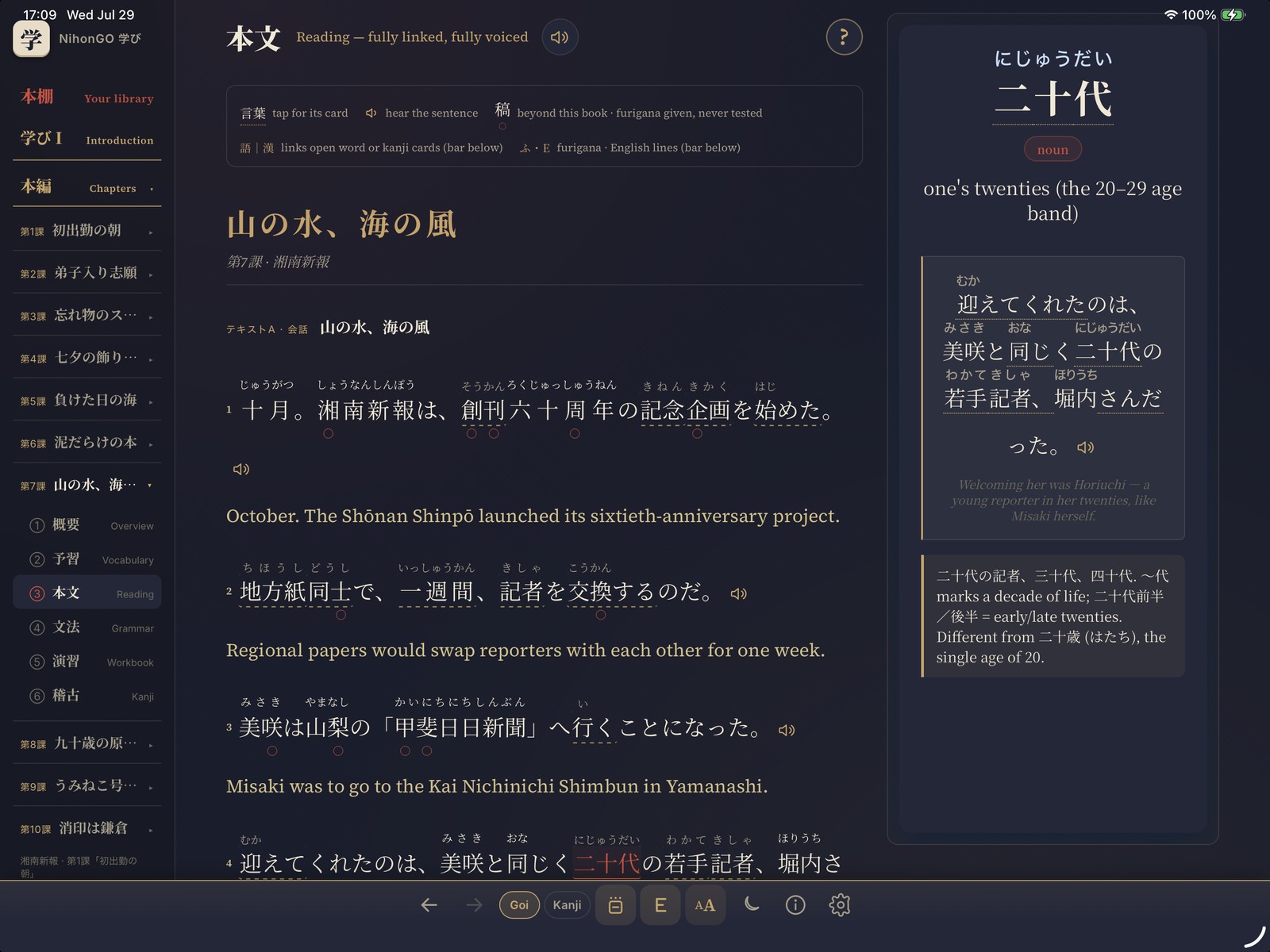
The reading section on iPad: Japanese text with furigana and per-sentence English, a tapped word open as a full card in the side panel.
β‘’ζœ¬ζ–‡ β€” the chapter text. Tap any underlined word and its card opens beside the page; every sentence can be read aloud.
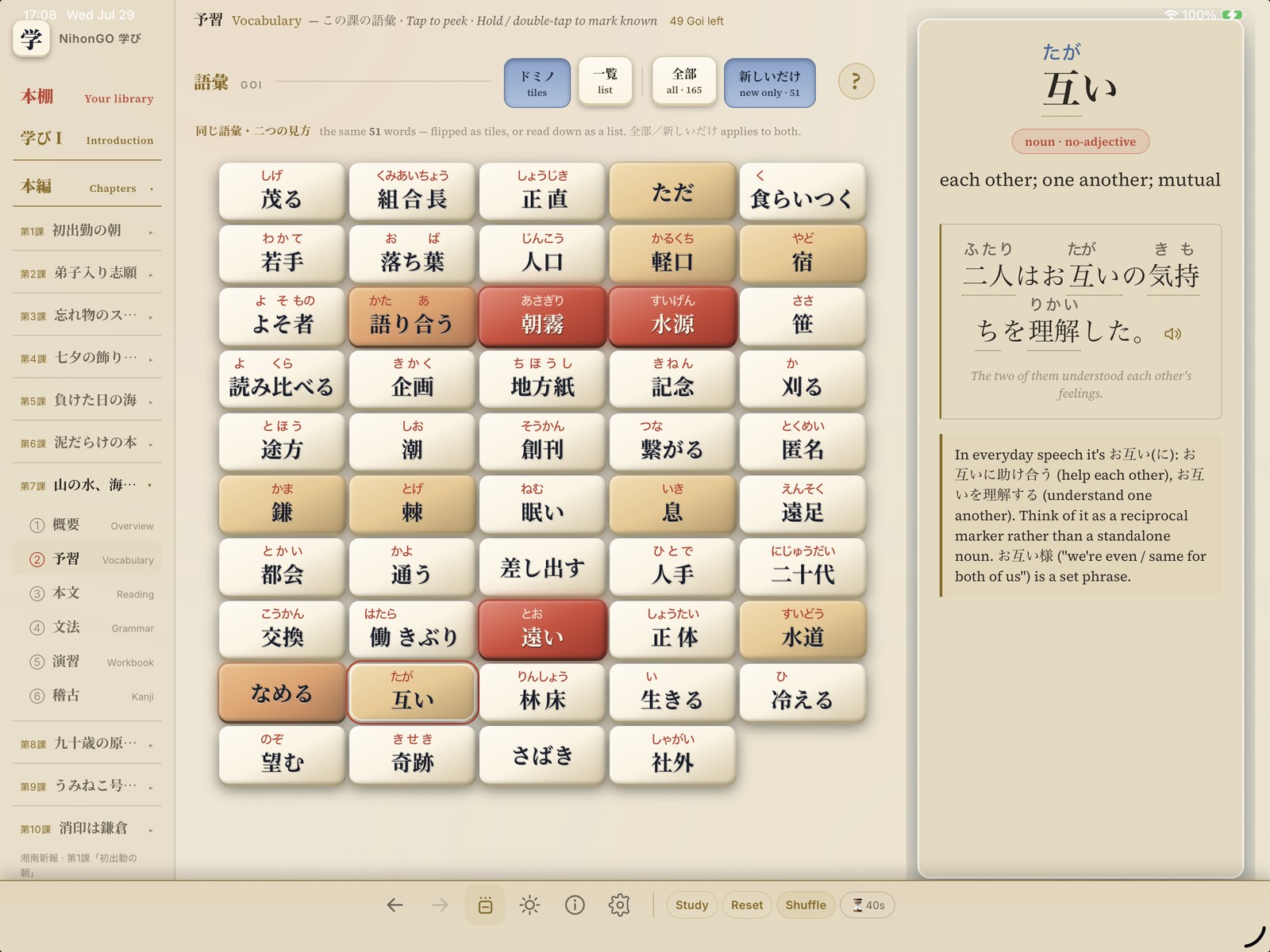
The vocabulary board on iPad: the chapter's words as tiles that deepen in colour as you peek at them, with an open word card.
β‘‘δΊˆηΏ’ β€” meet the chapter's words before you read them. Every peek deepens the tile; three peeks and it joins your review queue.
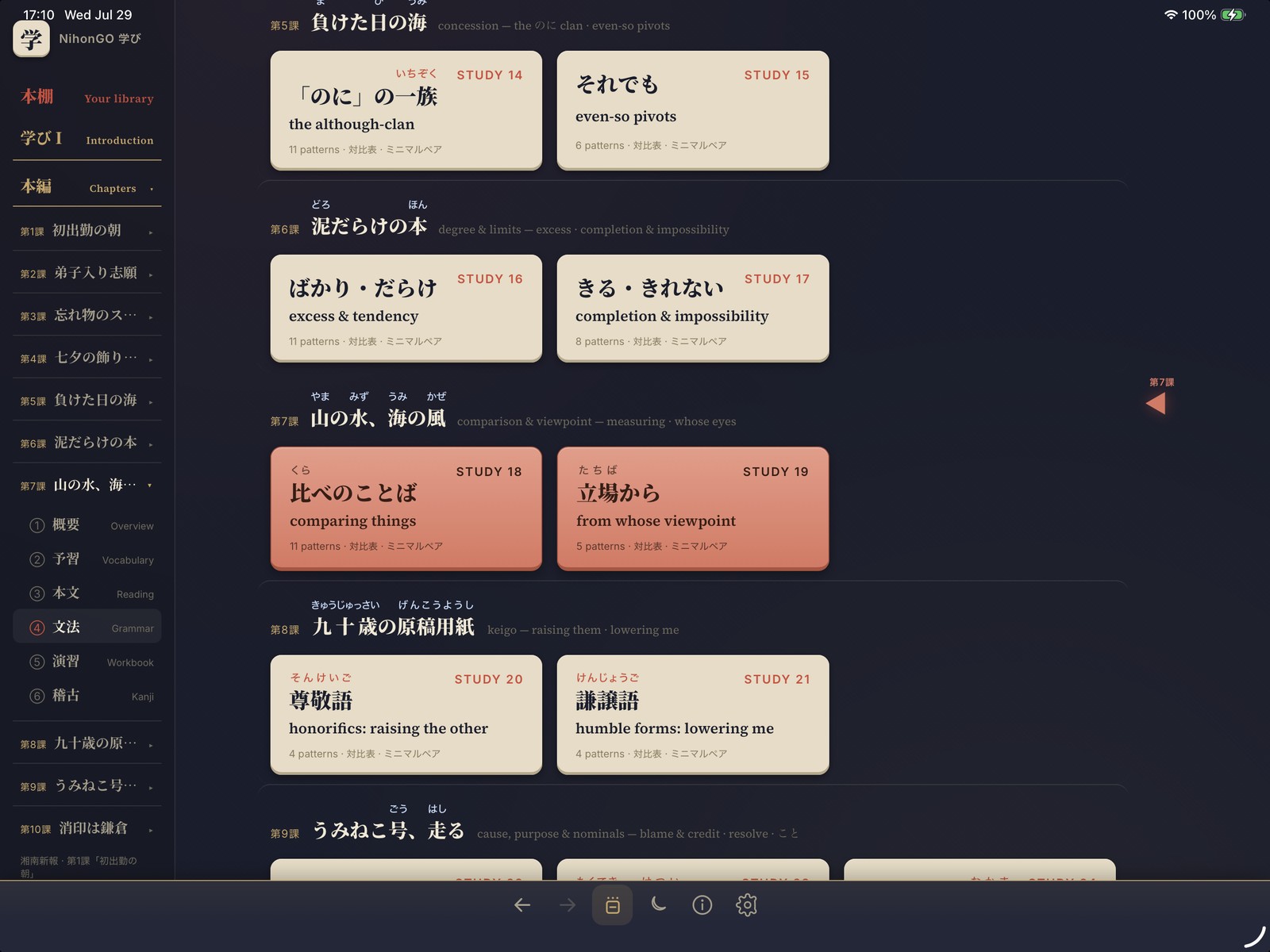
The grammar section on iPad: numbered studies grouped by chapter, each a family of patterns with contrast tables and minimal pairs.
④文法 β€” grammar gathered into families, not scattered points. Each study lays its members side by side, with contrast tables.
Every word is a live card

Nothing here is a dead list. Tap an underlined word and up comes its meaning, reading, the kanji it is built from and an example you can hear. Conjugated forms find their own dictionary form β€” ζ­©γ„γ¦γ„γŸ and ι…γ‚ŒγŸγ‚‰ open just like anything else.

Every N3 and N2 grammar pattern

Over 330 patterns across the series, taught as families rather than isolated points: every conditional side by side, every way of saying β€œcan”, so you learn which one to reach for. Plus all 755 N3 and N2 kanji, each introduced by the chapter that needs it.

A workbook that asks you to write

Around 7,500 exercises across the series, in several forms for every grammar family. You write the Japanese yourself, then the model answer shows how it should have been written β€” free, offline, as often as you like.

Handwriting, corrected stroke by stroke

Write a kanji with your finger or an Apple Pencil and it's checked for shape, stroke order, direction and missing strokes β€” and told which part of the character went wrong. Entirely on your device: no account, no connection, no cost.

It comes back

A word you keep peeking at, a kanji you keep missing, a pattern you keep getting wrong β€” all of it returns in a spaced review queue that schedules itself. You never add anything by hand.

An appendix that is actually useful

Complete reference tables, an index of every word and kanji in the book, printable practice sheets, and a dictionary with three scopes β€” this book, every card in the system, and a full Japanese–English dictionary of over 22,000 entries.
Arriving 15 December 2026 Β· iPhone and iPad Β· free, and free of accounts, ads and tracking
The companions

The course has two friends.

Manabi teaches. Dominos drills the same deck until it's automatic, and Dokusho puts it to work in real literature. One deck under all three β€” so nothing you learn in any of them is ever wasted.

NihonGO Dominos icon
NihonGO Dominos
On the App Store

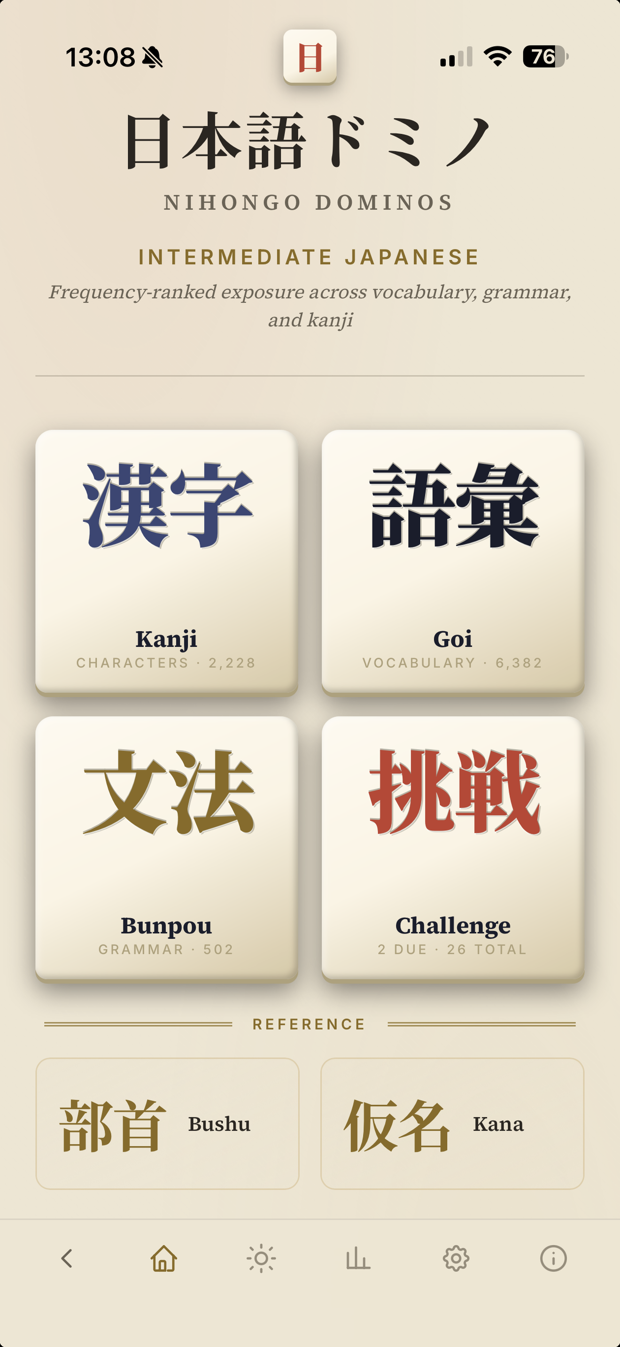
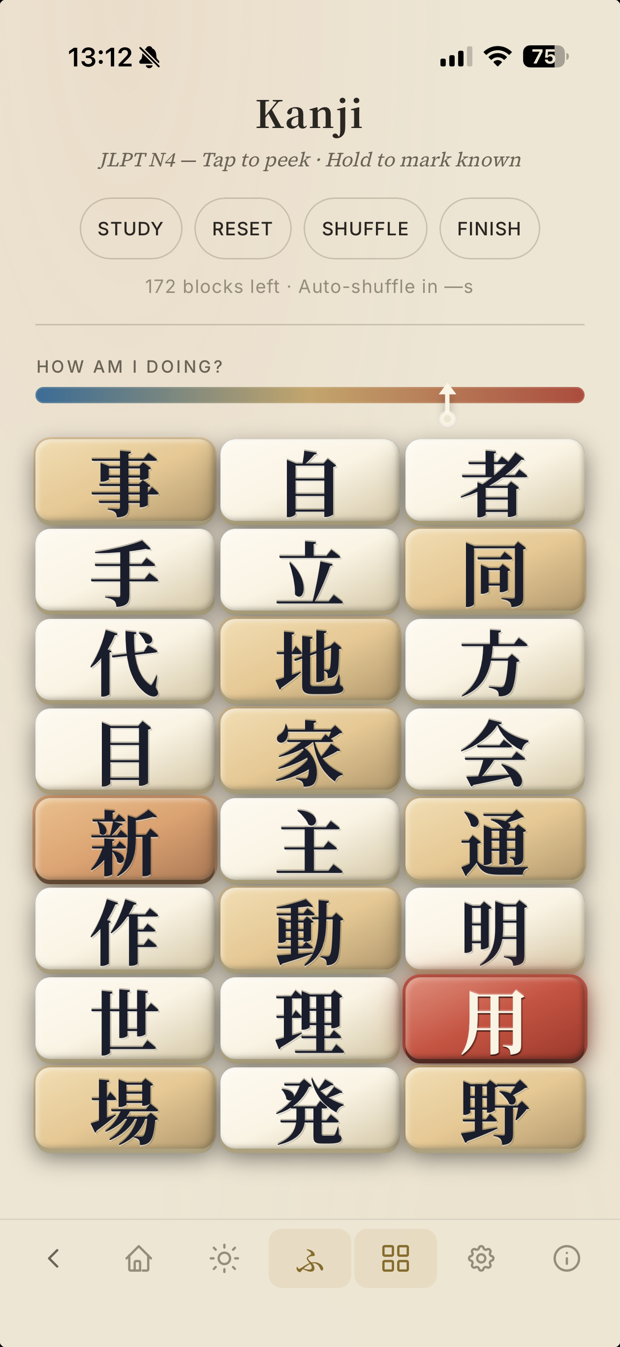
The drill. Rapid, frequency-ranked exposure to every building block β€” one thumb, on the train, every day.

  • Vocabulary, grammar, kanji and kana β€” frequency-ranked
  • A fast domino-matching loop built for daily repetition
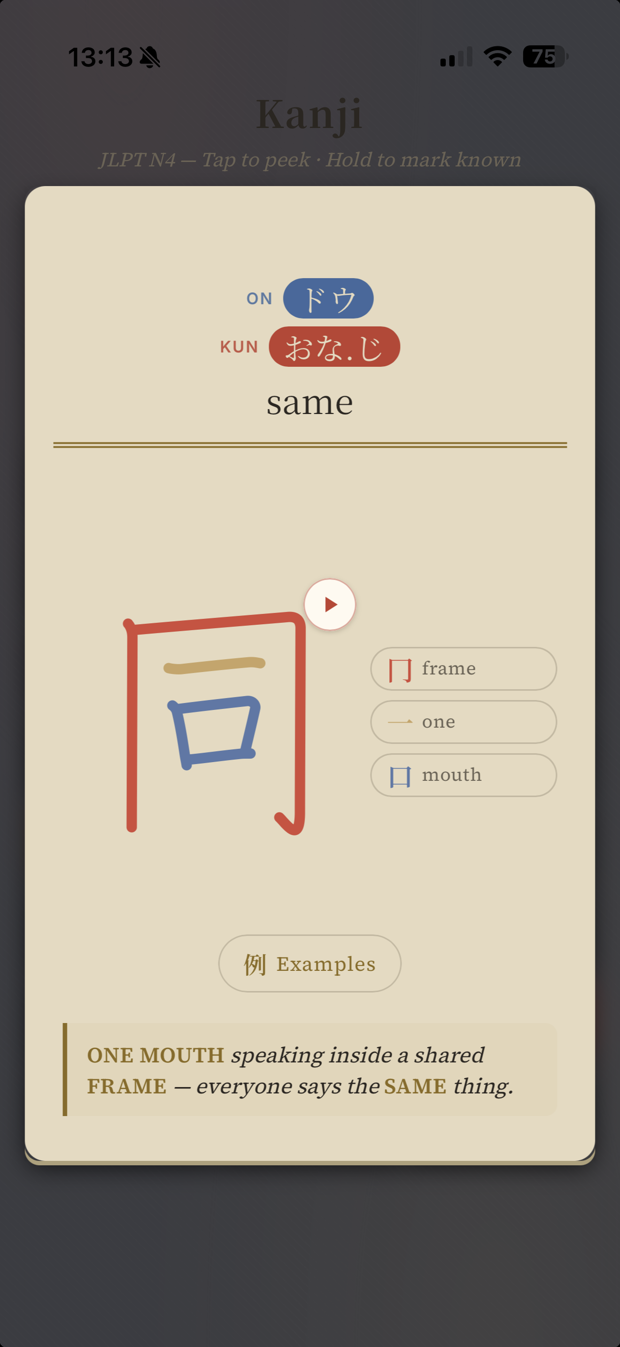
  • Stroke-order, audio, example sentences and compounds on every card
  • Offline-first. No accounts. iPhone & iPad. Free.
NihonGO Dominos home screen The kanji domino board A kanji card
NihonGO Dokusho icon
NihonGO Dokusho
On the App Store

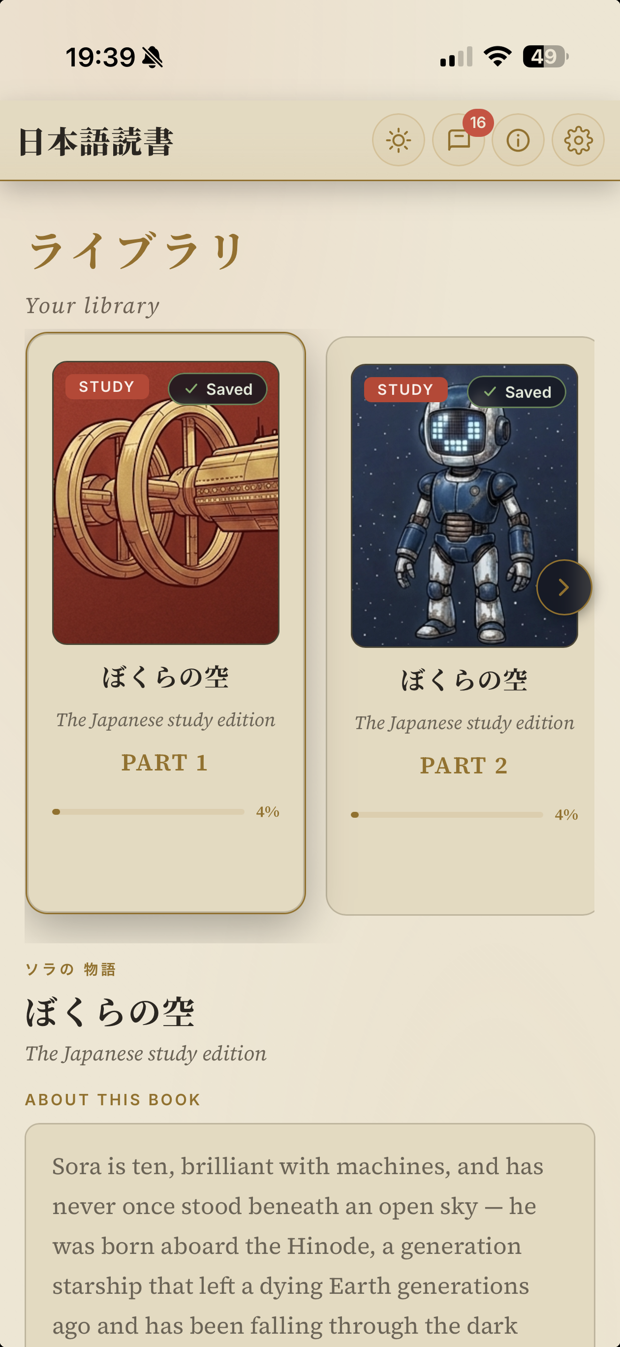
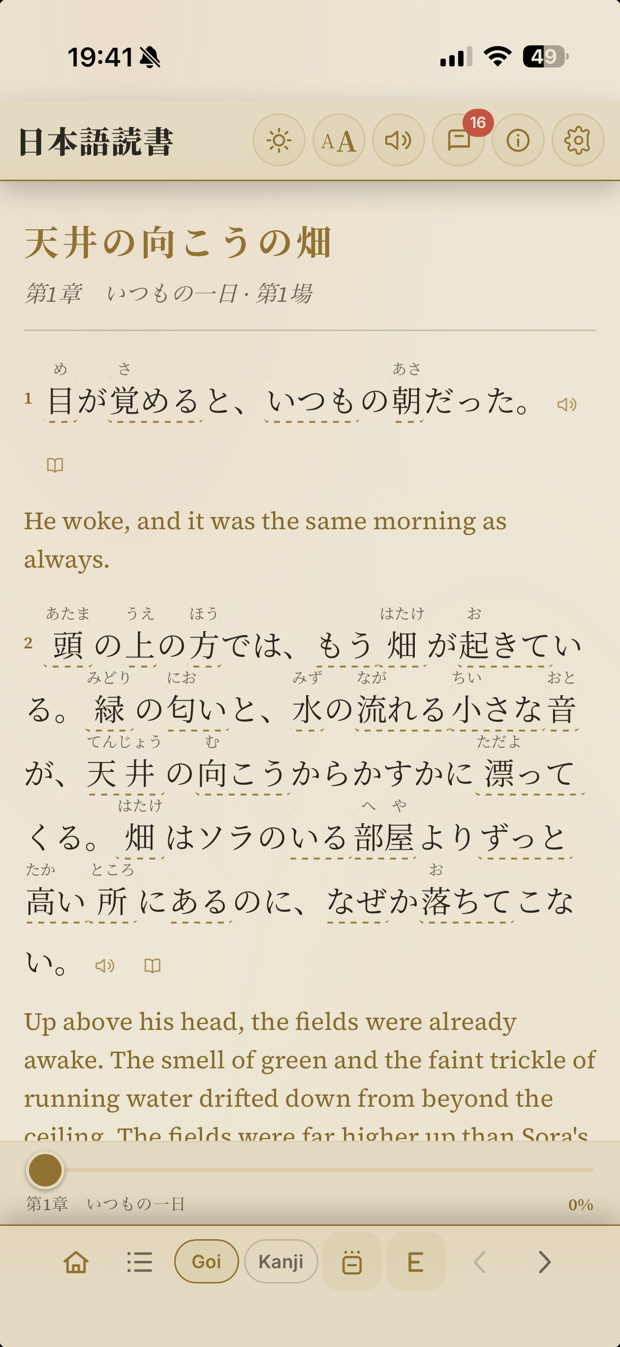
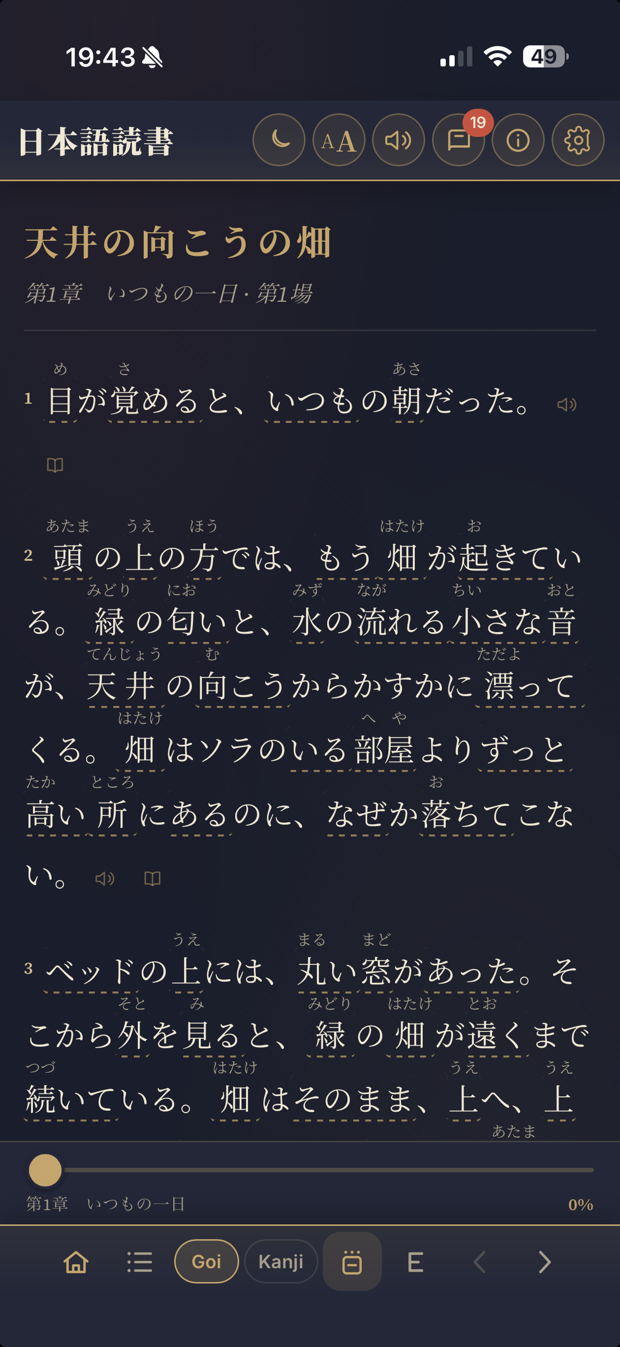
The reader. A graded Japanese novel where every word is alive β€” tap it, and up comes the very same card you met in Manabi.

  • Read real native prose with furigana you can turn on or off
  • Tap any word β†’ its full vocabulary, kanji or grammar card
  • Per-sentence English and a word-by-word grammar breakdown
  • Native voice narration. Offline reading. iPhone & iPad. Free.
The Dokusho library Reading a chapter with furigana Tap-to-study while reading
How it connects

One deck under all three.

Every word, kanji and grammar point lives in a single hand-curated deck. Meet it in Manabi, drill it in Dominos, then tap it inside a Dokusho story β€” the identical card appears. Recognition becomes reading.

γƒ‰γƒŸγƒŽ

Drill

Active recall of the blocks until they're second nature β€” ranked by how often you'll actually meet them.

学び

Learn

The course itself. Thirty-six chapters that introduce the words, the kanji and the grammar in the order a reader actually needs them β€” then make you write it back.

θͺ­ζ›Έ

Read

Meet those same blocks in longer literature β€” in context, with a tap-to-reveal card the moment you need it.

One shared deck

Hand-built and frequency-ranked. It grows with the books β€” and every app that reads it inherits the growth.

7,761Vocabulary
519Grammar
2,234Kanji
AllKana
Content

Two are here. The road is dated.

γƒ‰γƒŸγƒŽ Dominos and θͺ­ζ›Έ Dokusho are on the App Store today. Here is exactly what else arrives and when β€” because a course with a date you can hold it to matters more than one that is merely announced.

Manabi β€” the course

Dec 15学び I β€” finished, and it is a whole book. Twelve chapters. 194 N3 grammar patterns, the 254 most frequent N3 kanji and 2,499 writing exercises β€” built into the book, not sold beside it. On the App Store 15 December 2026.
Dec 15学び II β€” the grammar closes here. Twelve more chapters. Completes N3 with its remaining 120 kanji, opens N2 with 130 more, and teaches every N3 and N2 grammar pattern the series has left β€” after Book II there is no new grammar to learn.
Dec 15学び III β€” the vocabulary book. The final twelve chapters, and the longest stories in the series. The remaining 251 N2 kanji arrive carried by word families rather than lists, and no new grammar is introduced β€” everything from Books I and II is put back to work.

Dominos β€” the deck

NowOn the App Store today. Thousands of vocabulary, grammar and kanji cards plus every kana β€” fully built and curated. Free, offline, no account.
NowOn every card. Readings, audio, stroke-order, example sentences, radicals and compounds.
CompleteThe deck is complete β€” by design. Every JLPT N5–N1 kanji and grammar pattern, and the full intermediate vocabulary frequency range. The master card repository behind the family keeps growing, but the Dominos deck is a finished, curated set β€” that is the didactic point.

Dokusho β€” the library

Nowβ€œOur Sky” β€” the complete novel, all five books. Twenty-five chapters of an original graded novel, fully study-layered and read aloud β€” every book on the App Store today.
NowTwo companion editions. The same story as a plain Japanese edition and a full English translation β€” finish the study edition, then read it as a native would.
OngoingNew books, regularly. A growing shelf of original graded stories, all on the same tap-to-study deck.
The craft

Built like a reference, not a flash-card dump.

Every entry is curated and cross-checked β€” put through a multi-stage editorial pipeline before it ever reaches your screen.

Hand-curated

No machine-generated word lists. Each pillar is sourced, ranked and reviewed by hand.

Native-first Japanese

The chapters are written as Japanese first, then reviewed line by line by independent native readings β€” never translated out of English.

Frequency-first

You learn what you'll actually meet β€” ordered by real-world frequency, not textbook order.

Yours to keep

Everything works offline, on your device. No accounts, no ads, no tracking. Free β€” the content is the product.

Out now

Open the book. The rest is a tap away.

All three apps are free and built for intermediate learners.

Dominos and Dokusho are on the App Store now. All three 学び Manabi books arrive together on 15 December 2026.

Β© 2026 NihonGO Β· Shinagawa–Yamanote No accounts Β· No ads Β· No tracking